Why Expert Advice Doesn’t Work
Work 9 to 5 for 40 years. Skip your coffee. Save 10% of your income. Put money aside for retirement. Invest in an index fund — and in 40 years, you’ll be a millionaire. True, but in a wheelchair.
Who gives this advice? Almost every financial expert. But here’s the question: did these experts get rich thanks to their “groundbreaking” ideas, or thanks to the courses and seminars they sell?
They teach us to drive in the slow lane on the road to wealth, while they themselves enjoy the fast lane.
The Book That Changed My Mindset
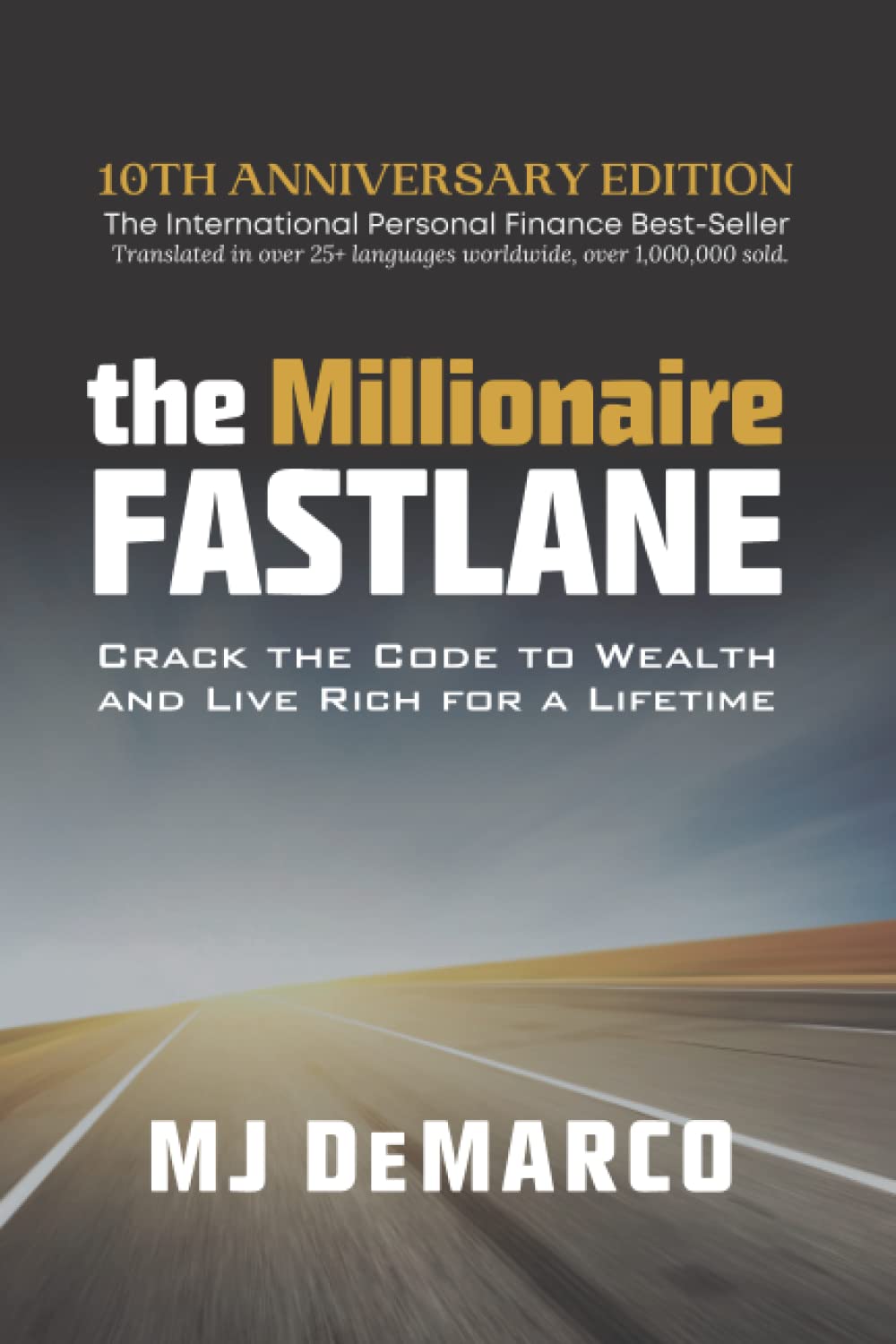
When I was 20, I found a book that flipped my understanding of money, wealth, and life upside down. It was The Millionaire Fastlane: Crack the Code to Wealth and Live Rich for a Lifetime by M.J. DeMarco.
Today, I want to share with you a detailed breakdown of this book. If you dream of wealth but don’t want to wait until old age, this article is for you.
Part One. The Race for Wealth
Long ago, a great Egyptian pharaoh summoned his nephews — twins Chuma and Azur. He tasked them with building two enormous pyramids in honor of Egypt.
The pharaoh promised each of them a reward: a kingdom, wealth, and a lifetime of luxury. But there was one condition — each had to build the pyramid alone.
Azur’s Slow Path
Azur immediately began working. He slowly dragged massive heavy stones to the foundation site. After several months, the base began to take shape.
Meanwhile, Chuma hadn’t moved a single stone. Azur was puzzled and went to his brother for advice. He found Chuma working on a strange device made of ropes, wheels, and levers.
“What are you doing?” Azur exclaimed. “You’re supposed to be building your pyramid!”
“I am building my pyramid. Leave me alone,” Chuma smiled.
A year passed, and Chuma still hadn’t laid a single stone.
Hard Work vs. System
Azur reinforced the foundation and began building the second tier. But he faced a problem: the stones were too heavy. He had to seek help from Ben, the strongest man in Egypt. For a fee, Ben trained Azur to become stronger.
Despite his efforts, construction went slowly. Still, Azur was ahead of his brother — after all, Chuma had no pyramid at all. By his calculations, it would take him 30 years to complete it.
Chuma’s Breakthrough
Three years later, Chuma returned. He unveiled a machine with ropes, wheels, and levers that quickly transported heavy stones.
What took Azur two months, Chuma’s machine accomplished in just two days. In only 40 days, he achieved what Azur had been struggling with for years.
After 8 years, Chuma completed his pyramid:
- 3 years — to build the system,
- 5 years — to use it.
The pharaoh kept his word: Chuma was granted a kingdom and riches. He never had to work again.
Meanwhile, Azur kept hauling stones, exhausting his body and finances, until one day he died of a heart attack. He had only two tiers left to complete.

The Moral of the Story
Azur symbolizes the slow lane to wealth. There’s no guarantee you’ll ever reach the finish line. At any moment, life can intervene: illness, death, or simple exhaustion.
Chuma is the fastlane example. His path wasn’t easy either — he worked hard, but not on stones; he worked on a system.
- 3 years of preparation,
- 5 years of work,
- and wealth for a lifetime.
The fastlane still requires years of effort, but it’s a different kind of work: building systems that work for you.
Three Paths to Financial Well-Being
Wealth doesn’t have to take decades. Yes, any path requires effort and persistence, but strategies differ. Some lead to freedom faster, while others keep people stuck in routine for life.
- The Sidewalk — Life Without Purpose
The sidewalk is living only for today, with no plans or strategies. People of all incomes can end up here: the poor, the middle class, and even the wealthy.
They earn $50,000 but spend $100,000. Income rises to $200,000 — and expenses grow even faster. Even millionaires can find themselves on the sidewalk if their spending outpaces their earnings.
The sidewalk is the endless chase for instant gratification: new gadgets, designer clothes, luxury cars, vacations for Instagram photos. But it’s a road to nowhere.
- The Slow Lane — Sacrificing the Present for the Future
The slow lane is for those who sacrifice today’s comfort for tomorrow’s illusion of stability.
They get an education, land a “secure” job, save 10% of their income, and hope to retire at 65.
This model is drilled into us since childhood by parents, teachers, and financial experts. But the truth is, no matter how hard you pedal, a tricycle will never become a race car.
Yes, you’ll accumulate some money — but you’ll enjoy it when your health and energy are already gone. Is it worth it?
- The Fastlane — Entrepreneurship and Creating Value
Now let’s look at real-life examples:
• A natural deodorant startup sold for $100 million in 4 years.
• A mobile app reached over 50,000 sales.
• A YouTube channel monetized through subscriptions and merchandise.
What do these stories have in common? The people chose the fastlane.
Unlike consumers, they became creators. Instead of buying products, they made them. Instead of digging for gold, they sold the shovels. Instead of endlessly scrolling, they produced content.
A fastlane business allows you to earn even while you sleep. Take the book The Millionaire Fastlane itself, written in 2010 and still generating income for its author.
But let’s be clear: the fastlane is not “easy money.” It demands building systems, skills, and sustained effort. Remember Chuma from the pyramid story: he spent three years creating his machine and another five working before reaping the rewards.
 “Mental Upgrade” is your guide to transformation: from fear to strength, from chaos to clarity, from survival to dream. Enter your email below to receive your free chapter.
Conclusion
There are three paths to wealth:
• The Sidewalk — spend more than you earn and live only for today.
• The Slow Lane — deferred wealth at the cost of decades of labor.
• The Fastlane — entrepreneurship, innovation, and creating value.
Want to Get Rich While You’re Young? Choose the Fastlane
The key is to change your mindset: stop being a consumer and start being a creator.
Beliefs, Actions, and Speed: What Really Leads to Wealth
Many financial bloggers and experts with hundreds of thousands of followers repeat: “Financial well-being is a long process, don’t expect instant results.” And that’s true — but only partly.
The richest people in the world didn’t become successful by chance. Likewise, those who struggle financially didn’t end up there by fate. Both groups simply follow their beliefs — and those beliefs define their path: some choose the sidewalk, others the slow lane, and some take the fastlane.
Beliefs Shape Reality
If you believe buying a new Mercedes on credit will make you happier, you’ll likely do it — and then spend six years paying it off. If you believe only index fund investing leads to wealth, you’ll follow that path.
Our beliefs are an inner compass. If it’s set wrong, it leads us astray. That’s why the journey to financial success doesn’t begin with money — it begins with mindset.
The Law of Attraction and Action
Visualization and the law of attraction can be useful, but only as the first step. M.J. DeMarco himself spent two years visualizing his book: he imagined the cover, took pictures of bookstore shelves, and “placed” his book there. But the book was born only when he started writing it daily.
He could have said: “I don’t know how to build a website, I don’t know how to write ad copy.” Instead, he sat down and self-educated. The internet, books, free YouTube lessons — that was his university.
The real question is: are you ready to become a lifelong student?
The Myth of the Perfect Moment
“Someday I’ll start: after exams, after vacation, when the kids grow up…” — we all know this phrase. But the reality is, the perfect moment doesn’t exist.
Microsoft, FedEx, and Facebook were all founded by students while still in school. They didn’t wait for the right time. They simply seized the opportunity.
The rule is simple: it’s now or never.
Speed Matters
An idea by itself is worthless. Millions come not from thoughts but from the speed of execution. Instagram started as a geolocation app, but the team quickly pivoted, offering the world a simple tool for sharing photos.
Don’t be afraid to launch. The market will tell you what to change and where to go.
Start Small
Want to earn $10,000 a month? First learn how to make $10. Then $100. Then $1,000. That’s how skills and confidence grow.
It’s like sports: you can’t become an Olympic champion if you don’t even know how to swim.
Focus on One Thing
Don’t spread yourself thin. DeMarco shared how he once tried to run two projects in parallel. The new one distracted him from his main business, and he had to shut it down.
Every success story is built on focus: LeBron James focused on basketball, Messi on football, Silicon Valley entrepreneurs on one product. Only once it succeeds do they branch out into other ventures.
Wealth Is a Process, Not an Event
When an athlete signs a $100 million contract, we see the event. But behind it are years of training, losses, and effort.
When a young entrepreneur sells a startup for $50 million, the headlines show the numbers. But behind it are sleepless nights in garages, risks, loans, and relentless work.
The price of success is the process itself. And it is that process that turns an ordinary person into a millionaire.
The Price of Success and the Five Commandments of the Fastlane
Success Has a Price
Many dream of an easy road to wealth, but the reality is this: the fastlane demands high commitment. You’ll face overwork, relationship struggles, and lack of free time. It’s a road few dare to take.
Yes, the journey will be bumpy. But remember: you shape your path. Success is a process that demands dedication.
• Interest fades after the third failure.
• Commitment remains even after the hundredth.
Dealing with Negative Influences
On the road, there will always be people saying: “It won’t work,” “Someone’s already doing it,” “Why bother?” The key is not to let their doubts destroy your vision.
Your environment influences everything — even productivity. DeMarco shared how living in Chicago drained him because of constant gloomy weather. Lack of sunshine hurt his mood and motivation. So he moved to sunny Arizona, where he built his business.
If you feel constant fatigue or irritation, reconsider your work or circle. You’re not a tree — you can move.
Time Is the Most Valuable Resource
On average, people spend about 4 hours a day on social media and TV. Over a lifetime, that’s 9 years in front of a screen. Yet this time could be invested in building a system that generates income for decades.
In the fastlane, time is seen as an asset to be invested in growth — not wasted.
Partnerships and Clients
Strong partnerships can accelerate business growth. But you must choose partners wisely. Two weeks of communication aren’t enough to know if someone is reliable. Business cooperation is like marriage — it requires attention and trust.
And here’s another key: listen to customer complaints. They reveal what can be improved. But filter them — not every complaint deserves a reaction. What matters is responding quickly and caring for those who bring the most value.
Great customer service is expensive, but it always pays off. A product can be excellent, but poor service can ruin the business.
Lifelong Learning
The knowledge you have today may not be enough for tomorrow’s challenges. Use every free minute: listen to podcasts, audiobooks, read in transit or waiting rooms.
But avoid excessive multitasking. It kills focus. Simple tasks can be combined, but important work requires full attention.
Taking Responsibility for Your Fate
Complaints like “I was fired,” “I was cheated,” “The rent went up” reflect a victim mindset. But responsibility is always ours. If a contractor failed, it means you didn’t clarify the terms. If your job ended, it’s an opportunity to find new ones.
On the fastlane, you are responsible for your destiny.
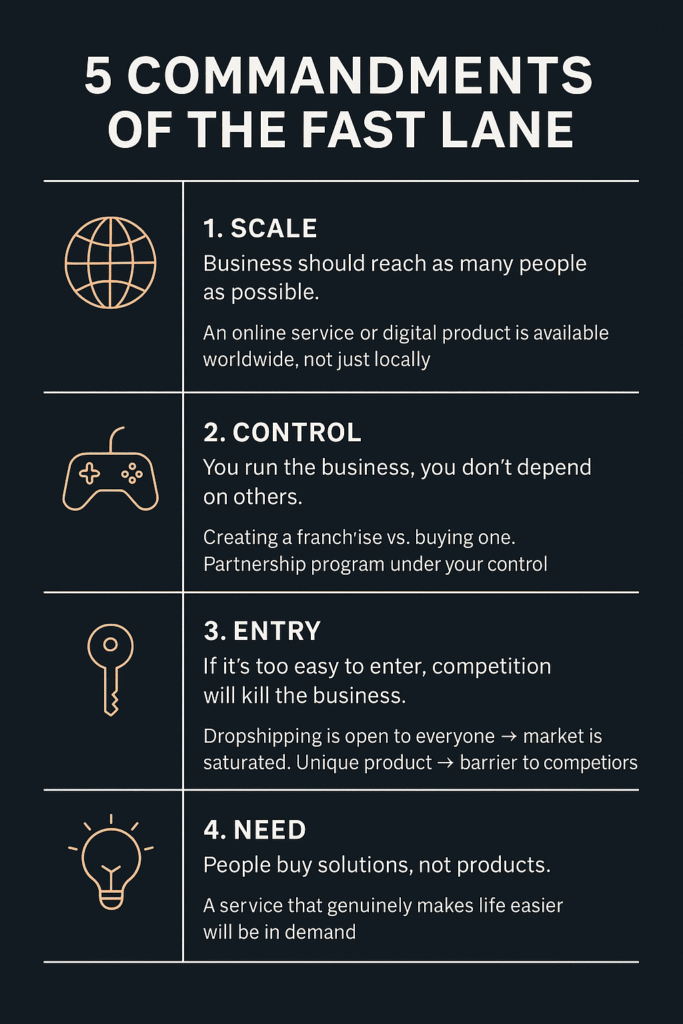
Part Four: The Five Commandments of the Fastlane
For a business to truly be an “expressway” and not just another trap, you must follow five commandments:
- The Commandment of Scale
The more people you help, the more you earn.
If your business is limited locally (like selling sandwiches in one neighborhood), it will never grow globally. But an online product or digital service can reach clients worldwide.
- The Commandment of Control
If you don’t control the business, you’re not the driver — you’re a passenger.
• Fastlane business owners create affiliate programs, they don’t just join them.
• They create franchises, they don’t buy them.
DeMarco once ran an affiliate program where a partner earned $20,000 a month. But DeMarco himself made $200,000 — while keeping full control. That’s the key: control = power over results.
- The Commandment of Entry
If starting a business is too easy, competition will crush you.
Dropshipping or “$200 businesses” are available to everyone. That’s why those markets are overcrowded. To stand out, your business must have barriers to entry: uniqueness, exclusivity, innovation.
- The Commandment of Need
Your business must solve a problem and provide real value.
People don’t need more faceless products. They need solutions to their specific problems.
Part Five. Scalable Systems and the Final Conclusion
The Commandment of Need
Before launching a business, it’s crucial to consider real demand. Joe, a martial arts instructor, opened a studio following the advice “do what you love.” But within 10 months, he had to close it down: there simply wasn’t enough demand in his area. Passion matters, but the key condition for success is alignment with market needs.
Take Ashlyn’s example: she loved art and literature, so she opened a coffee shop where local artisans could showcase their work. At first, it brought success. But over time, the business drained her energy. She worked until 8 p.m. every day. Staff came and went, and those who were reliable demanded salaries she couldn’t afford.
Her social life faded into endless work, leaving her with no time for herself. After three years, she shut down the café and returned to her previous job.
Ashlyn didn’t exactly fail—her café brought modest income. But the business simply didn’t match the amount of time she invested. She spent too much of her life inside the shop.
To build a truly successful business, it must include scalable systems that allow it to grow and eventually generate passive income. Without scalability, a business will never give freedom to its owner.
So here’s the big question: How can you build a large-scale and meaningful business without working around the clock? The more lives you can impact, the more successful and wealthy you will become.
What is scale? It’s the number of people your business touches.
For example: If you sell a mobile app to one million people and earn $7 from each, your income is $7 million.
What about significance? It’s the importance of the problem you solve. Surgeons are paid well because they solve life-and-death problems.
The bigger the problem, the higher the value of your product or service.
High Value = High Price = High Significance.
If you can combine scale and significance, your business can generate not just millions, but billions.
Steve Jobs built Apple by merging scale with significance—and built a fortune.
How to Impact Millions Without Being Present 24/7
To do this, use five systems:
• Computer and software systems. Don’t limit yourself to a single location. A website or app can connect you to millions worldwide. Think of software and app creators.
Bill Gates became one of the richest men on Earth after writing code that could be distributed to millions.
Nicholas, one of the iPhone developers, created a mobile game and earned $600,000 in a single month. He worked on it part-time, often coding with one hand while holding his infant son with the other. He couldn’t even afford books, so he learned online.
• Distribution systems. Make your product widely accessible. Starbucks and McDonald’s did this by opening 500+ locations and using franchising.
• Content systems. Create content that can be sold or monetized repeatedly—books, online courses, YouTube videos.
If you run a gymnastics studio, you can only teach a handful of people. But if you record and sell an online course, you can reach millions.
• Human resource systems. Build teams to drive growth. Amazon’s strength lies in its massive workforce, carefully managed to power long-term success. While large teams add complexity, effective management turns them into engines of growth.
• Rental systems. A powerful way to earn with minimal time. Real estate is one example, but there’s also digital real estate:
1.Photographers uploading work to stock sites.
2.Students selling notes online.
3. Content creators turning courses into digital assets.
The Commandment of Time
A business must function without your constant presence. Ashlyn’s café story proves: without scalable systems, your project becomes exhausting. To achieve freedom—not chains—you must automate and design your business to earn even when you’re not there.
The Five Commandments of Fastlane Business
- Scale — Your product or service must reach a wide audience.
- Control — You must be in charge, not dependent on others.
- Entry — If entry is too easy, competition will kill your project.
- Need — Your business must solve real problems.
- Time — Your system must generate income without your constant effort.
Recommendation
If you want to reprogram your mindset, break free from limiting beliefs, and build a strong foundation for personal and financial success — I recommend my book “Mental Upgrade.”
Inside, you’ll find practical tools for transforming your thinking, creating productive habits, and strategies for achieving your goals.
👉 Get your copy of Mental Upgrade
The Five Scalable Systems
To build freedom and wealth, leverage systems that impact millions:
• Computer/software systems — apps, websites, SaaS.
• Distribution systems — App Store, Amazon, franchising.
• Content systems — books, courses, YouTube.
• Human resource systems — strong teams.
• Rental systems — physical or digital assets
Conclusion
Fastlane business is not about quick money but about building systems that provide freedom and scalability. Success requires sacrifice, hard work, and discipline. Yet, by creating a business on these principles, you gain not only income but also true freedom.
Useful links
- Amazon KDP: how to publish your book –
- Harvard Business Review — articles on leadership
SEO Keywords
• fastlane business principles
• scalable business systems
• financial freedom mindset
• entrepreneurship and discipline
• build passive income systems
• MJ DeMarco fastlane ideas
• mindset for success
• business scalability and freedom
“Mental Upgrade” is your guide to transformation: from fear to strength, from chaos to clarity, from survival to dream. Enter your email below to receive your free chapter.