
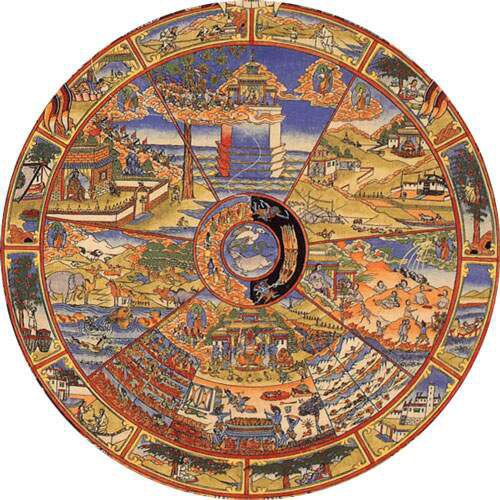
Reincarnation (from the Latin reincarnatio — “re-embodiment, repeated incarnation”) is traditionally understood in two ways:
- A religious–philosophical concept claiming that certain immortal essences (souls, spirits, etc.) undergo repeated embodiments after bodily death or under other circumstances.
- A theory of human rebirth into other beings.
But what is the Christian perspective on reincarnation?
Christianity and the Rejection of Reincarnation
From the earliest centuries, the Christian Church firmly rejected the idea of the transmigration of souls. This doctrine contradicts essential revealed truths:
- the Christian understanding of the soul and the body,
- the state of the soul after death,
- the Particular Judgment,
- the future resurrection of the dead,
- and the Last Judgment.
A central dogma of Christianity asserts the bodily resurrection and eternal life in restored and transfigured bodies — a belief fundamentally incompatible with reincarnation.
Early Christian writers repeatedly stressed the inconsistency of reincarnation with the Gospel.
St. Gregory of Nyssa on Personal Identity
Reflecting on the resurrection, St. Gregory of Nyssa wrote:
“What would resurrection mean for me if someone else rises instead of me? How would I recognize myself if I no longer see myself in me? I will not truly be myself if I am not in every way identical with myself.”
Misunderstandings About Early Christian Belief
Some thinkers whose ideas vaguely resembled reincarnation (though not in the modern sense) included Origen, whose teachings on the pre-existence of souls were condemned at the Fifth Ecumenical Council.
In later centuries the idea appeared among medieval Cathar gnostics, who believed each soul was a fallen angel reborn again and again in a material world supposedly created by Lucifer.
In the late 19th and early 20th centuries, certain Theosophists tried — without evidence — to present reincarnation as an early Christian belief supposedly “removed” later. Modern New Age adherents often repeat this claim, but it has no historical foundation.
Want to discuss this further? Join the conversation on our forum: Search For Truth — Forum
Christian Philosophical Critique of Reincarnation
Beyond biblical arguments, Christian theologians and philosophers highlight serious contradictions within the idea of reincarnation itself.
1. No Authentic Memory of “Past Lives”
People do not remember any previous existence. Reports of “past-life memories” are often:
- false memories (confabulations),
- the result of hypnosis or guided imagery sessions,
- influenced by cultural environments where reincarnation is taught.
Such memories never appear spontaneously — only under influence.
2. Reincarnation Does Not Solve the Problem of Justice
Instead of explaining undeserved suffering, reincarnation claims all suffering is deserved because of past lives. But this leads to contradictions:
- The chain of causes and effects extends infinitely backward — which is logically impossible.
- If souls have no beginning, there could be no “first life,” and therefore no initial cause for suffering.
- Christianity, rejecting reincarnation, teaches that evil and suffering arise from free will, not from punishments for forgotten past lives.
3. Reincarnation Does Not Improve Moral Behavior
A soul embodied in a new body — especially an animal — cannot understand:
- the nature of its previous sins,
- why it suffers,
- or what it needs to change.
As philosopher V. K. Shokhin notes:
“Becoming lower animals or demons, the punished must only deepen in their degradation, with no chance of escape.”
Thus reincarnation provides no adequate moral motivation.
4. Reincarnation Divides the Human Person
Justice requires that moral consequences apply to the whole human person, not to a fragment of identity carried from life to life. Reincarnation destroys personal integrity.
5. No Moral Foundation in Pantheistic Systems
Many reincarnation-based worldviews deny objective good and evil. But if morality is an illusion:
- karma cannot be just,
- punishment becomes arbitrary,
- and suffering loses any moral meaning.
6. Reincarnation Discourages Compassion
In some Hindu interpretations, helping a suffering person worsens their karma by interrupting their “repayment.” This belief historically justified:
- social inequality,
- indifference to the poor,
- acceptance of suffering as deserved punishment.
It becomes an instrument of oppression.
7. Modern Science Contradicts Reincarnation Explanations
Ancient philosophers used reincarnation to explain:
- birth defects,
- differences in intellect,
- developmental delays,
- and personality traits.
They lacked knowledge of genetics.
Today science explains these phenomena naturally, undermining reincarnation as a useful hypothesis. If medicine reduces suffering, does it “cancel karma”? This contradicts karmic law itself. Historical evidence shows societies believing in reincarnation often neglected medical care for the vulnerable.
8. Reincarnation Fails to Produce a Better Humanity
If the theory were true, humanity — through endless cycles — should have become morally superior by now.
But history shows no such universal moral progress.
💬 Share your experience
A short 1-question survey about belief in reincarnation based on Christian teaching. Share your view and see how others answer.
 Loading ...
🙏 Thank you for sharing your answer! Every story helps us see how faith lives in the hearts of people today.
Are There Any Biblical References to Reincarnation?
The Apostle Paul states unambiguously:
“It is appointed for man to die once, and after that comes judgment” (Hebrews 9:27).
The term resurrection appears dozens of times in Scripture, while the term reincarnation does not appear even once.
Could Melchizedek Have Been a Previous Incarnation of Jesus Christ?
To accept such an idea, one would have to deny the divinity of Jesus Christ and dismantle the entirety of Christian dogmatic theology — something categorically impossible for a Christian.
Melchizedek is one of the mysterious figures of the Old Testament, mentioned only briefly. Paul writes that Melchizedek was:
“Without father, without mother, without genealogy, having neither beginning of days nor end of life” (Hebrews 7:3).
These words do not imply pre-existence or reincarnation. Instead, they indicate the absence of recorded genealogical information. Genesis shows that Melchizedek’s priesthood was absolutely unique—unlike anything else in Israel or surrounding cultures.
Thus, Paul uses Melchizedek as a type (prototype) of Christ, highlighting similarities in mission, not identity, essence, or reincarnation. Searching for reincarnation in this passage is completely unfounded.
Does God’s Love for Jacob and “Hatred” for Esau Before Their Birth Indicate Reincarnation?
Paul explains:
“Though they were not yet born and had done nothing either good or bad… it was said: ‘The older will serve the younger.’… So then it depends not on human will or exertion, but on God who has mercy.” (Romans 9:11–16)
God’s foreknowledge—not a supposed “karma” from past lives—determines the destinies of Jacob and Esau. God stands outside of time, and His choices relate to their future lives, not to some imagined past incarnations.
In the symbolic interpretation used by Paul:
- Esau represents ancient Israel,
- Jacob represents the new people of God — Christians.
This has nothing to do with reincarnation.
Does “Before I formed you in the womb, I knew you” (Jeremiah 1:5) Suggest Pre-Existence?
Context makes the meaning clear: God foresaw and appointed Jeremiah for a prophetic mission before his birth. This is about divine foreknowledge, not about a previous life.
Likewise, Psalm 89 says:
“You return man to dust”
which echoes the earlier:
“For you are dust, and to dust you shall return” (Genesis 3:19).
Neither passage has any connection to reincarnation.
Was John the Baptist a Reincarnation of the Prophet Elijah?
First, Scripture states clearly that Elijah never died, but was taken into heaven alive (2 Kings 2). His soul did not separate from his body, so it could not have “entered” John the Baptist.
Second, Elijah appears in his original body with Moses at the Transfiguration.
Third, when asked directly:
“Are you Elijah?” — John answered: “No.” (John 1:21)
Even Origen, respected by some supporters of reincarnation, wrote:
“How could the greatest among those born of women not know who he is?”
(Commentary on the Gospel of John)
So why then does Jesus say:
“He is Elijah, if you are willing to accept it” (Matthew 11:14)?
The key phrase is: “if you are willing to accept it”—a signal that Jesus is speaking figuratively. John came “in the spirit and power of Elijah” (Luke 1:17), meaning he continued Elijah’s prophetic ministry.
In the Bible, “spirit” does not mean “soul” but a divine prophetic empowerment. Scripture itself says:
“The spirit of Elijah rested on Elisha” (2 Kings 2:15)
without implying reincarnation.
Thus, Jesus’ words point to the missional continuity, not personal identity.
If Some Jews Thought Jesus Was a “Risen Prophet,” Did They Believe in Reincarnation?
Absolutely not. The people said:
“…others say that one of the old prophets has risen again.” (Luke 9:18–19)
This implies belief in literal resurrection, not reincarnation.
And since John the Baptist and Jesus were the same age and related (Luke 1:36), similarities in appearance and preaching naturally led to speculation—not metaphysical theories of reincarnation.
Does “Unless one is born again…” (John 3:3) Refer to Reincarnation?
The context reveals that Jesus speaks of spiritual rebirth in this life, not rebirth into another body.
Nicodemus clearly interprets Jesus’ words literally and asks:
“Can he enter a second time into his mother’s womb?”
Jesus clarifies:
“Unless one is born of water and the Spirit…” (John 3:5)
—referring to baptism, cleansing, repentance, and reception of divine life.
Water symbolized:
- purification,
- life,
- the overcoming of chaos.
Through baptism, a person becomes a new creation. This profound transformation can indeed be called a “rebirth”—as Augustine famously said:
“To become what you were not — that is a kind of death and rebirth.”
But this has nothing to do with occult theories of reincarnation.
How Does Science View Reincarnation?
The consensus in modern scientific research is clear: there is no verified scientific evidence for reincarnation.
According to the U.S. National Science Foundation, belief in reincarnation is one of the most widespread pseudoscientific beliefs among Americans.
Quotes on Reincarnation
(Patristic and Conciliar Witnesses Against the Doctrine of Reincarnation)
Constantinople Council, A.D. 1076
“To those who prefer the foolish so-called ‘wisdom’ of external philosophers, and follow their teachers, and accept the transmigration of human souls or claim that they perish like irrational animals and pass into nothingness, and therefore deny the resurrection, the judgment, and the final recompense for life — anathema.”
St. Gregory Palamas
“If you examine what the external philosophers mean by the command ‘Know yourself,’ you will uncover a chasm of false teaching: confessing the transmigration of souls, they believe that one attains self-knowledge by discovering with which body he was once connected, where he lived, what he did, and what he learned. This, they claim, is revealed when one submits to the deceitful whisperings of the evil spirit.”
Archbishop John (Shakhovskoy)
“It is impossible to accept the very principle of retribution which underlies the doctrine of reincarnation. ‘Fallen’ people are punished by an embodiment in which, on the one hand, in their degraded new state they cannot understand the measure of their past deeds nor the degree of their punishment; and on the other hand, they are firmly ‘fixed’ in this fallen condition.
In an animal state they are incapable of assessing their past, drawing conclusions, or correcting themselves. Thus the supposed retribution becomes a fiction.”
Blessed Theodoret of Cyrus
“How could such a judgment be just, if—according to the teaching of the unbelievers—the bodies do not rise, and only the souls are held accountable for sins?
The soul, which sinned together with the body, allowed envy and unworthy desires into itself through the eyes, was misled by unlawful words through the ears, and through every part of the body received some harmful impulse—how could it alone bear the punishment for these sins?
And is it just that the souls of the righteous, who together with their bodies practiced virtue, should alone enjoy the promised blessings?
Is it just that the body, which together with the soul accumulated the wealth of virtue, should remain dust and be abandoned, while the soul alone is crowned victorious?
If this is contrary to justice, then the bodies must first be resurrected, and only then, together with the soul, give account of their life.”
St. Nicholas of Serbia
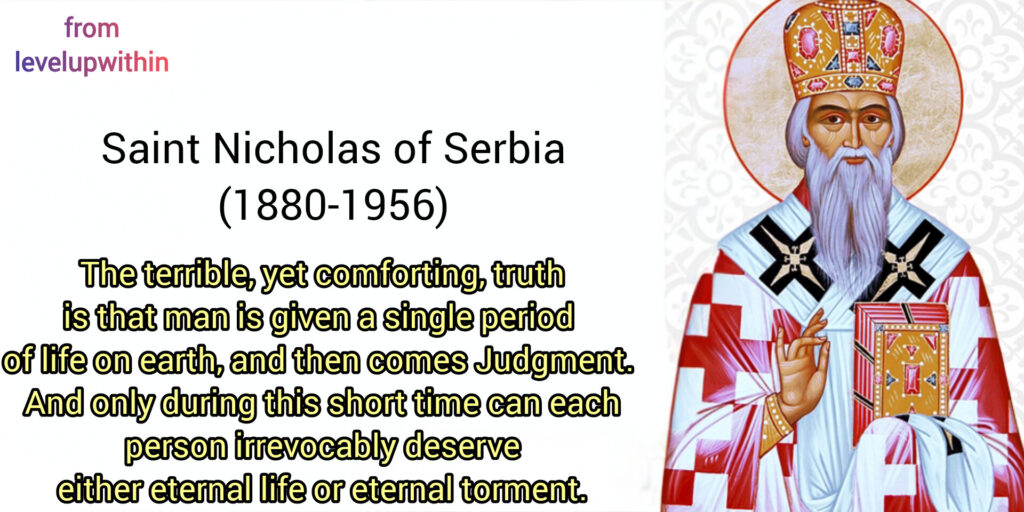
“A terrifying yet comforting truth is that man is given one term of life on earth, and afterwards — judgment. And during this brief term he may irrevocably deserve either eternal life or eternal torment.”
S. V. Posadsky
“Man is the Image of God — a personal being endowed with reason and free will, for his Creator possesses Reason and the highest freedom.
The teaching of transmigration degrades the human person, turning him into a cog in an impersonal law, according to which he repeatedly loses his unique personality and even descends to the level of animal or vegetable existence.”
V. Yu. Pitanov
“In sectarian teachings, God is usually impersonal. A person can speak with a personal God, and a personal God can forgive.
An impersonal system, however, makes room for the laws of karma and reincarnation, thereby turning a human being into a puppet of faceless forces.
The law of reincarnation lowers moral responsibility: one lives sinfully in this life and will ‘correct himself’ in the next.”
St. Irenaeus of Lyons
“We can refute their teaching of the transmigration of souls from one body to another by the fact that souls remember nothing of what happened to them before.
For if they were created to experience every sort of activity, they ought to remember what was done earlier, so as to make up what is lacking and not continually engage in the same things nor suffer such miserable toil — for union with the body could not entirely destroy memory and clear perception of what was formerly, especially since they supposedly came into this world for that purpose.”
📝 Conclusion
The idea of reincarnation may seem appealing to modern people who desire “another chance” or a long chain of self-improvement. Yet the Holy Fathers, Sacred Scripture, and the unbroken tradition of the Orthodox Church clearly reveal a different truth. Humanity is given a single earthly life and a single path to salvation — through a living relationship with God, who calls each person to freedom, responsibility, and love.
Reincarnation distorts the Christian understanding of the human person and reduces human uniqueness to a cycle of impersonal rebirths. Orthodoxy, however, offers a much deeper and brighter promise: the resurrection, transfiguration, and eternal life in communion with God.
✅ Final Summary
Orthodoxy rejects reincarnation not out of rigidity or tradition for its own sake, but because it contradicts the truth about human identity, freedom, and eternal destiny. The Christian vision is not restrictive but hopeful: every human being is uniquely precious to God and is given one meaningful, sufficient path toward salvation.
Keywords:
orthodoxy reincarnation, orthodox teaching on the soul, patristic quotes on reincarnation, reincarnation heresy, life after death orthodoxy, what the church says about reincarnation, orthodox view of reincarnation
Tags:
Orthodoxy, Reincarnation, Christian theology, Afterlife, Church Fathers, Heresies, Soul and salvation, Resurrection of the dead, Eastern Orthodox teaching, Spiritual life, Eternal life, Christian anthropology, Patristic quotes, False doctrines, Orthodox Christianity
Want to discuss further?
🙏 Every journey begins with awareness.
In my book “Mental Upgrade”, I share how faith, mindfulness, and inner strength help overcome fear and begin a new way of living
💭 Want to reflect on what you’ve just read?
Take a short quiz to deepen your understanding and explore your spiritual growth.
Start the quiz now →